27 May 2025
443 Queen Street, Brisbane by WOHA
27 May 2025
In contrast to densely packed apartments that extend to the edge of the floor plate, the “baggy” design of this residential high-rise creates space for climate responsiveness and urban connectivity – and leaves a legacy that will shape local design governance and policy.
When Singapore’s WOHA comes to town, it’s tempting to focus on the practice’s penchant for striking vertical gardens or the “urban verandahs” elevated several storeys above the ground floor. These are trademark WOHA architectural moves, found in well-known buildings such as the Parkroyal Collection Pickering (Architecture Australia, Vol. 102, No. 5) in Singapore. Each of these design assets can be found at 443 Queen Street, a Meanjin/Brisbane residential tower designed by WOHA. (Local firms Architectus and Kris Kowalski Architects contributed to the project as design, documentation and delivery architects.) More than just a translation of WOHA’s ideas into a subtropical context, it’s a building that asks, and answers, questions about what buildings mean to Meanjin. WOHA has previously worked in Australia, contributing to the design of Forbes Residences in Perth with MJA Studio and CAPA, and The Hedberg in Hobart with Liminal Studio (Architecture Australia, Vol. 110, No. 2). But Meanjin’s subtropical climate, which shares similar characteristics with tropical Singapore, poses a unique opportunity to showcase WOHA’s expertise. The need for air movement from natural ventilation to combat stifling humidity for both human comfort and building health is a must in hot and humid climates. WOHA co-founding director Richard Hassell describes the practice’s method for increasing ventilation in highrise apartment buildings as “baggy” design – generating spaces where the volume exceeds the floor plate.
Bagginess is a biomimicry strategy where the surface-area-to-volume ratio of the building is expanded, mirroring the larger curved or folded leaves of many plants in tropical and subtropical climates, which provide greater access to daylight, water capture and transpiration to stay cool. In buildings, an increased surface-area-to-volume ratio improves access to natural ventilation and daylight and helps maintain thermal comfort, especially cooling. The tendency for Australian apartment buildings to tightly pack dwellings to the very edge of the floor plate – where the facade is skin-tight – does not leave space for this type of climate responsiveness. When we do dense, we take it to an extreme.
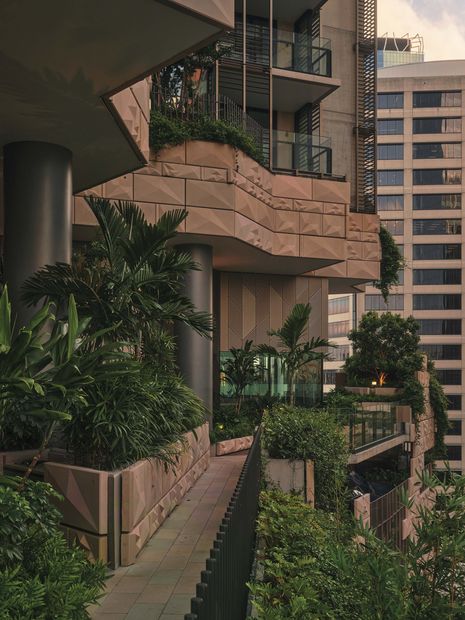
The folding forms of the building envelope provide visual interest and expression while also leaving room around the floor plates for the building to breathe. Image: Cieran Murphy
The result of the baggy approach, in the case of 433 Queen Street, is a building envelope exuding sumptuous folds of structural fabric that provide visual interest and expression while also leaving room around the floor plates for the building to breathe. Expanding the surface area of the building goes beyond the envelope and is a driving force behind the plan. The apartment floor plates are laid out in a butterflied formation, with the units unfolding as wings from an “open core.” This cracking-open unfurls the building, providing a view over the Maiwar/Brisbane River framed by lush tropical planting as you step out of the lift to each floor. There is a genuine sense of arrival, a place to pause and catch a breath, provided by this gesture. The folding-out of the apartments focuses the view from living areas and bedrooms on the more expansive view along the river, rather than across it. It also facilitates the articulation of the form, with each bedroom and living area protruding uniquely. In one strike this increases the building surface area and provides space for doors and windows on perpendicular, opposing and adjacent edges, promoting cross ventilation.
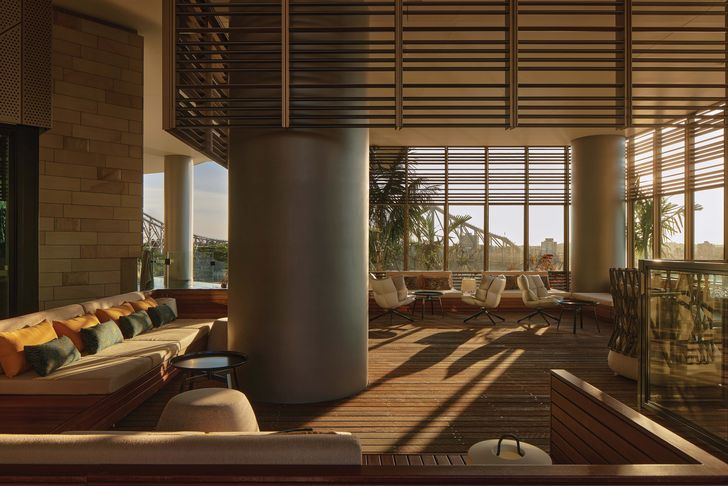
As part of the energy elimination strategy, unnecessary mechanical ventilation to non-habitable spaces was omitted, reducing energy loads. Image: Cieran Murphy
The open core negates the need for any mechanical ventilation to central and circulation spaces. This is premised by a strategy of “energy elimination,” which involves minimising energy loads by avoiding unnecessary climate control to non-habitable spaces. Elevating the car park above ground with access to open air was also part of the energy elimination strategy. The opportunity to minimise energy consumption is afforded to individual apartments through access to natural ventilation and the provision of internal private drying yards in each apartment for hanging and drying clothes, instead of using a dryer. The drying yards are co-located with a roomed laundry and facilitated by awning windows that open to narrow-shafted internal atriums, broken into three-storey segments, pocketed within the open core. As with all good apartment design, each space needs more than one use, and a popular use for these drying yards is accommodating pets. When entertaining guests, residents can simply close the laundry door to conceal all the paraphernalia that accompanies owning pets – just like living in a suburban detached house.
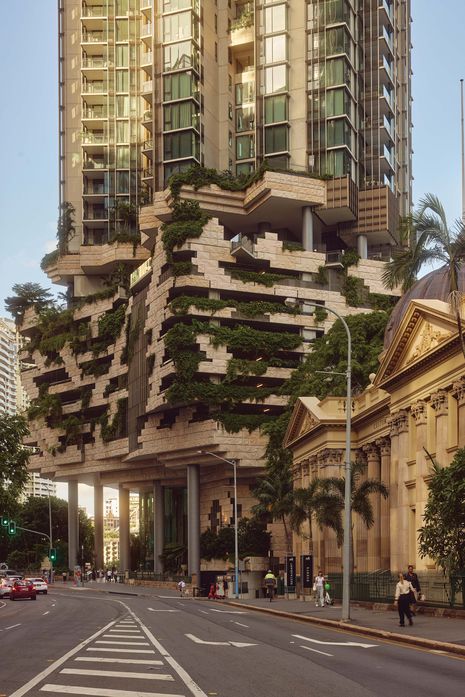
The concept of porosity determined the ground floor height, which ensures uninterrupted views from the public domain to the Maiwar/Brisbane River beyond the building. Image: Cieran Murphy
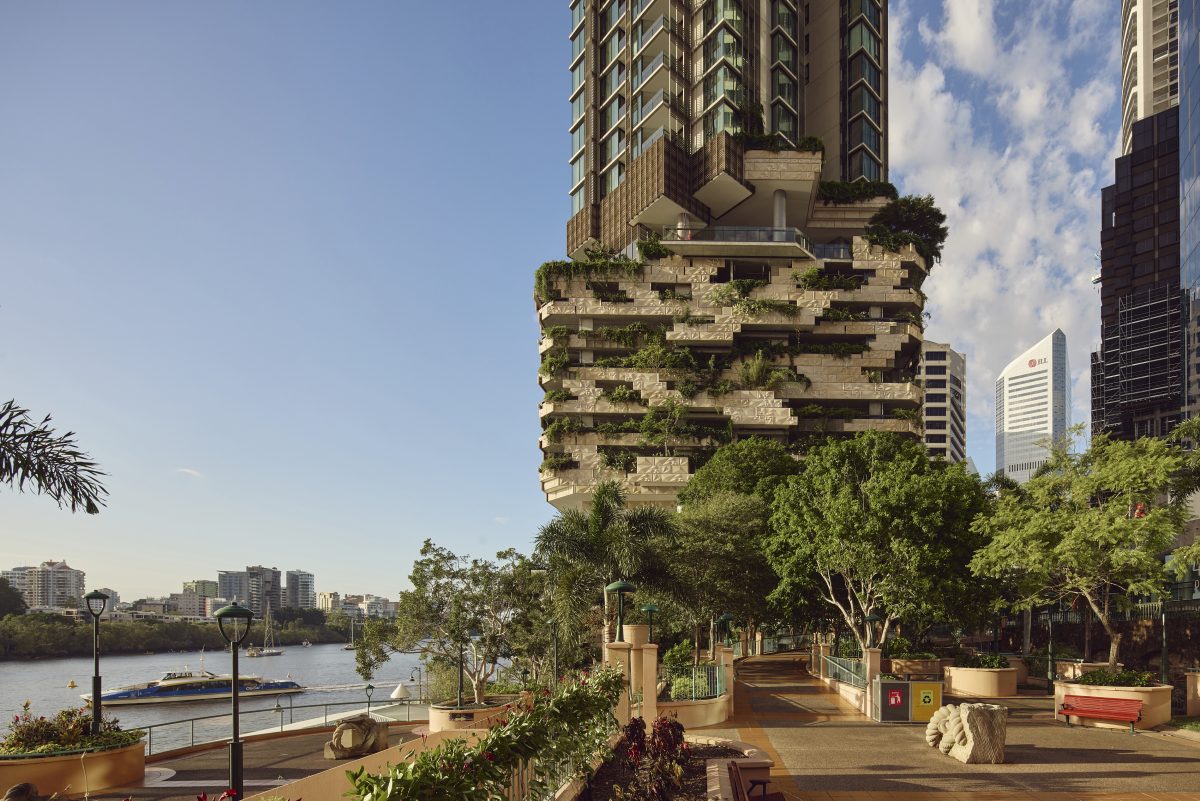
All these functions are facilitated by the building’s porosity – small openings and interstitial gestures that facilitate connection between community, built space and the natural environment. It brings to mind Walter Benjamin and Asja Lacis’s 1925 essay “Naples,” where they expressed that the city was not made up of individual buildings but stitched together by the porous spaces in between – the balconies, small openings, crevices and spaces that connect and separate.1 The porous nature of 443 Queen Street is illustrated in both its small gestures and some of its big moves. The ground-floor height is driven by an uninterrupted view line from the public domain of the street to completely capture the Story Bridge beyond the building. To maintain this view, the entry foyer to the tower is constrained to the utmost. It’s an important move because the building that previously occupied the site blocked both visual and physical access to the river from Queen Street. Hassell observes that “a very nice thing” that Australians do well is incorporating the public realm within large-scale projects.
Materially, porosity defines the ability for buildings to exchange air and gases – the ability to breathe. Fittingly, 443 Queen Street proffers an exemplary case study for Brisbane City Council’s Buildings That Breathe design guidelines. 2 It addresses all eight elements specified in the document for designs that properly respond to the city’s climate: “Orientate yourself,” “Occupy outdoor spaces,” “Illuminate with daylight,” “Natural air and ventilation,” “Shade and protect,” “Living greenery,” “Identity matters,” and “Reduce energy and waste.” The building aligns well with more detailed principles included in the guidelines, especially its use of city rooms and sky terraces. (WOHA’s Parkroyal Collection Pickering is featured in the guidelines as a case study for living greenery – the only international case study referenced in the document.)
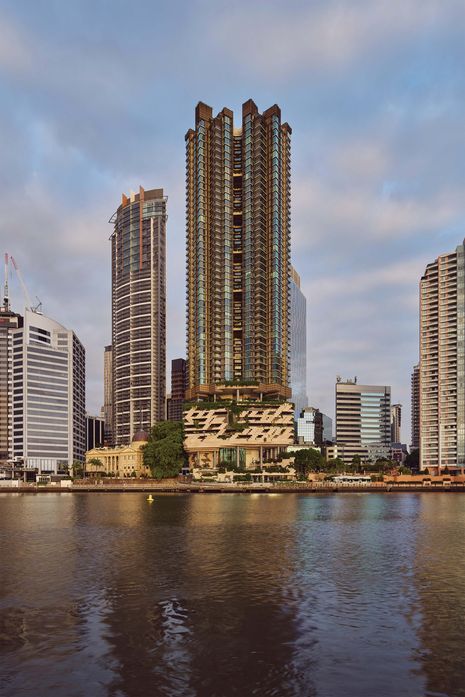
The project is an important case study for the Buildings that Breathe design guidelines as part of Brisbane City Council’s New World City Design Guide. Image: Cieran Murphy
Porosity is not a new concept in WOHA’s work. Many of the underpinning ideas for this building can be found in its 2016 book Garden City Mega City: Rethinking Cities for the Age of Global Warming (with Patrick Bingham-Hall). The book proposes a reinvention of the twentieth-century garden city movement and advocates for multi-layered, high-density “micro-urbanism” that intensifies land use while enhancing quality of life through vertical greenery, natural ventilation and sustainable resource management. The approach involves carving out smaller villages within the larger city, often described as vertical neighbourhoods, fostering connection and community within individual buildings or between adjacent buildings. It is a great gift to find a text written by architects that clearly explicates their approach to practice.
Realising the project has taken the efforts of many, from council planners who brought breathing buildings to the top of the agenda, to the building’s architectural collaborators, to the client, Cbus Property – including senior development manager Michelle Fitzgerald (a former practising architect) who had the vision to bring WOHA to Brisbane and drive the quality of the project on behalf of the organisation.