8 Apr 2026
205 North Quay by Hassell, REX and Richards and Spence
MARCH 2026
As reported in the Australian Institute of Architects on 30 March 2026
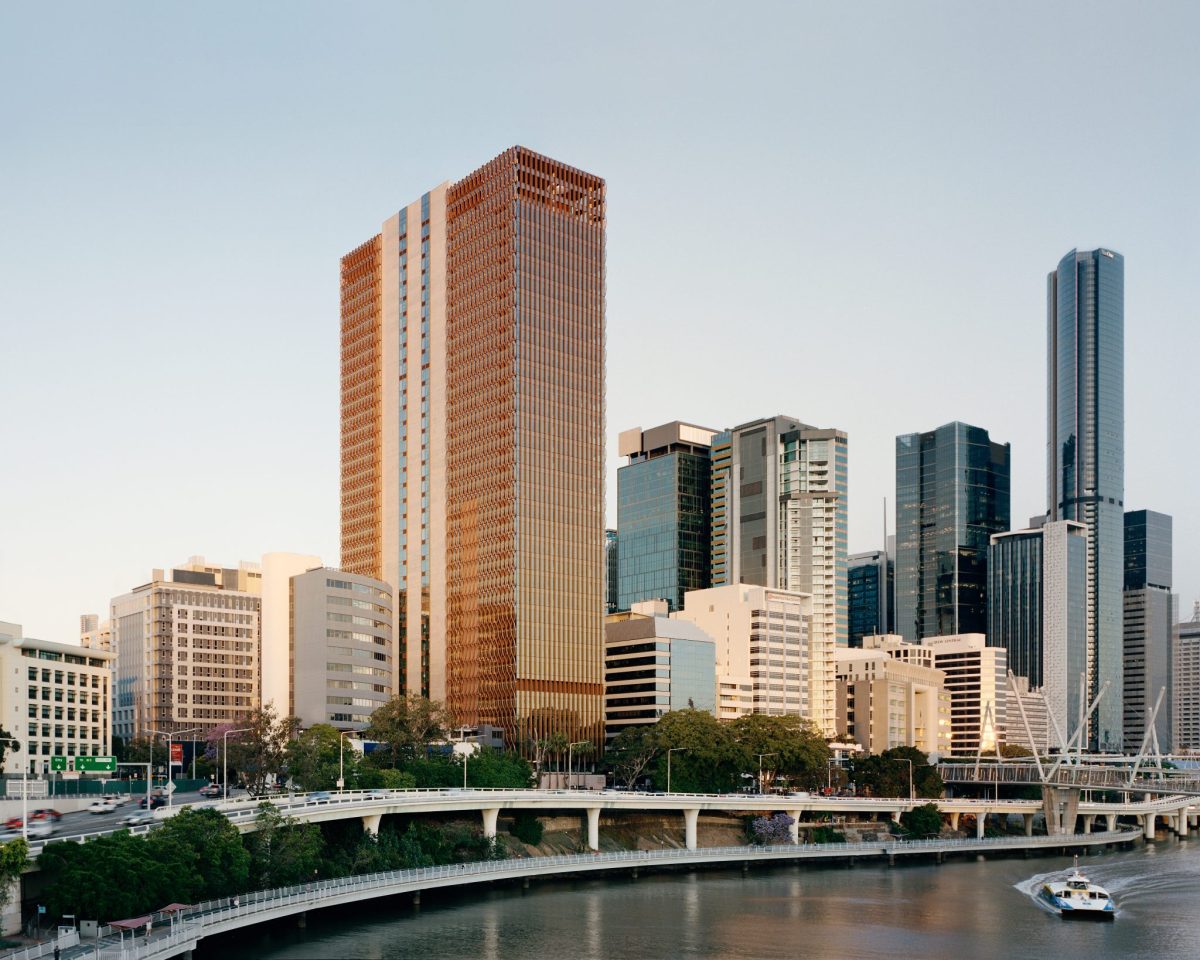
Emerging from an unusually constrained competition process, 205 North Quay achieves a rare sense of spatial and formal continuity across a complex, multi-authored project.
By the time an office tower is physically realised, much of its value has already been constructed elsewhere: in spreadsheets, leasing strategies, market forecasts and the prestige economy that surrounds premium commercial development. Within that world, the presence of an international architect can become part of the formula too, lending distinction before any design proposition has been tested in use. The 205 North Quay project belongs, at least in part, to that culture, but it is not defined by it.
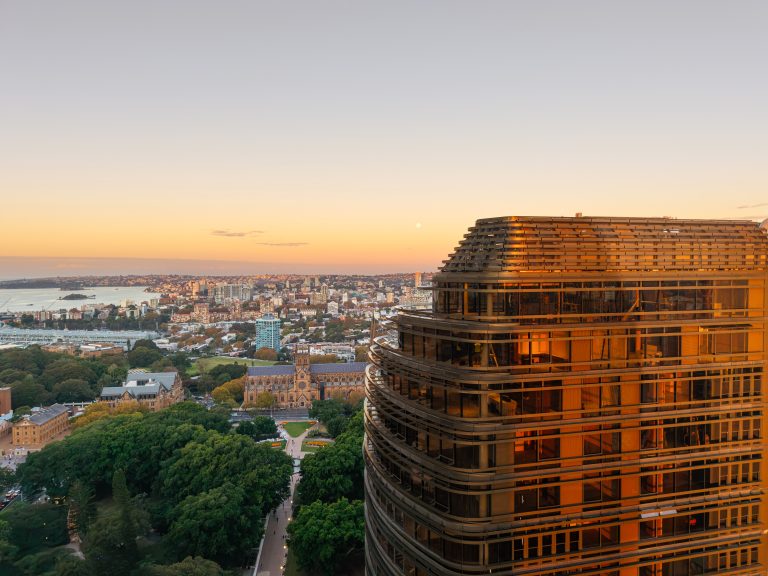
Its origin seems worth noting. Cbus Property asked design competition teams to present without renders, limiting them to ten A3 sheets and forcing the proposal to stand on the clarity of its argument rather than the atmosphere of its imagery. That decision does not guarantee a better building, but here it seems to have mattered. The collaboration between Hassell, REX and Richards and Spence produced something unusually continuous in its spatial and formal expression. There is little sense of the building having been split into separate authored parts by different design teams. The building does not read as a tower simply landed on a podium, nor as a local base made to support an imported object above. The project feels worked through from ground to skyline, with the same ideas carried across structure, section and envelope.
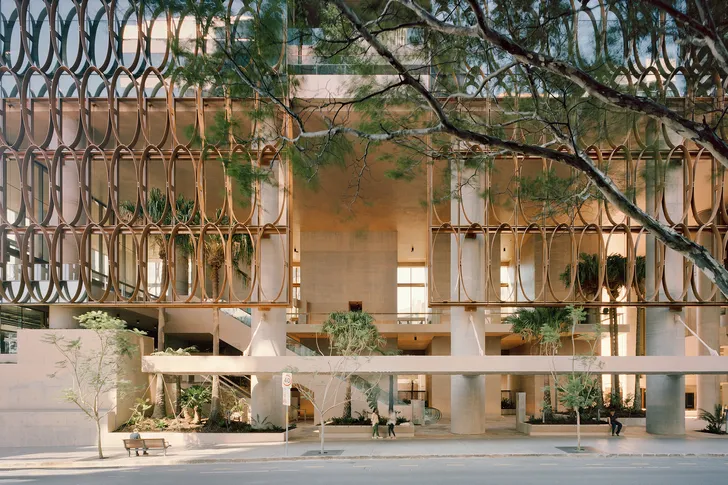
The commercial lobby is lifted clear of the street, creating an open but shaded plaza at the base of the building. Image: David Chatfield
That sense of continuity is clearest at the ground. The commercial lobby is lifted clear of the street, allowing the base of the building to become an open, shaded plaza. The architects call it an “open-air urban room,” though there’s a risk this characterisation lends civic dignity to privately controlled space. Here, the description seems fair enough, given the space’s architectural weight, proportion and material presence, which give it a genuinely civic character. Much of the plaza’s spatial effect comes from the exposed concrete structure, which does not present as a pristine surface set against public life, but as something that engages with it. The columns meet the ground unadorned, apart from their mineral blush tint, and at full tower scale they create a monumental colonnade. Meanwhile, the lift cores stand within the space as large concrete volumes that further shape the space’s weight and measure. The plaza reads not as the leftover void beneath a tower but as a grand urban chamber with serious spatial force.
What makes the space convincing is not openness alone but protection. The decision to enclose the loading dock at the North Quay end turns the site’s noisiest edge into a buffer. Rather than giving the riverfront over to traffic and service, the building uses its thickness to shield the plaza and allow the more inhabitable ground plane to settle into shade, planting and relative calm. This move also sets up the section above, where a vertical sequence of increasingly protected spaces emerges, with the elevated hospitality spaces and auditorium occupying a more protected register above the street, while the sky lobby pushes that sense of removal further. The ascent through the building’s vertical void reads less as circulation between amenities than as a gradual shift in atmosphere.
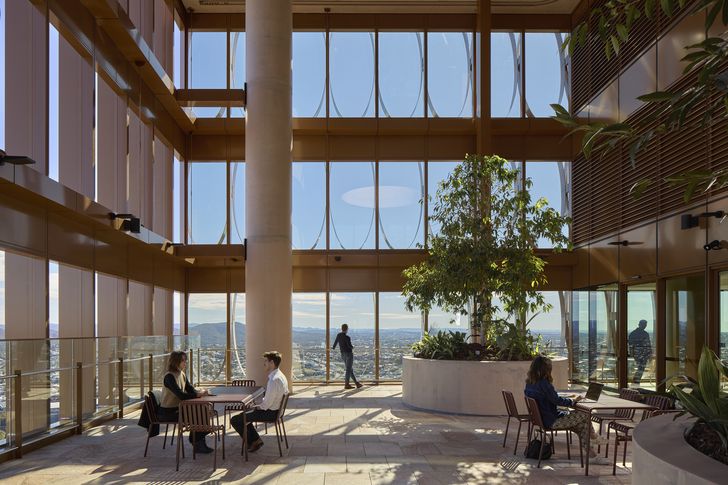
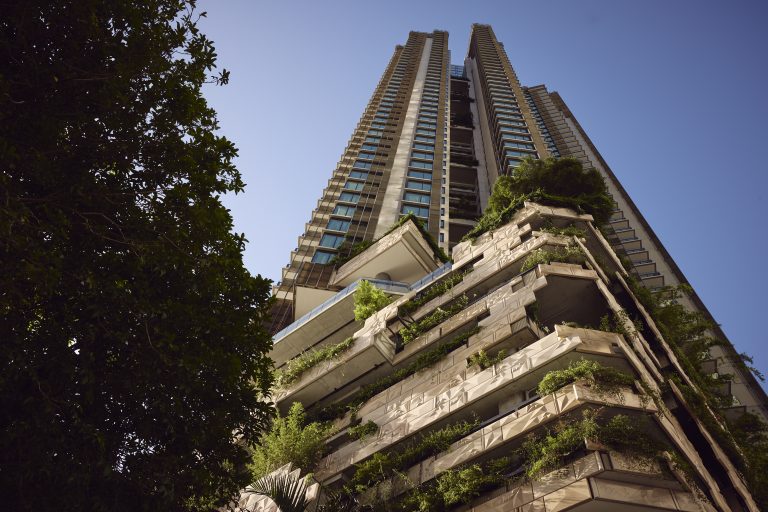
Landscaped outdoor terraces ascend the tower, creating third spaces for breaks and meetings. Image: Cieran Murphy
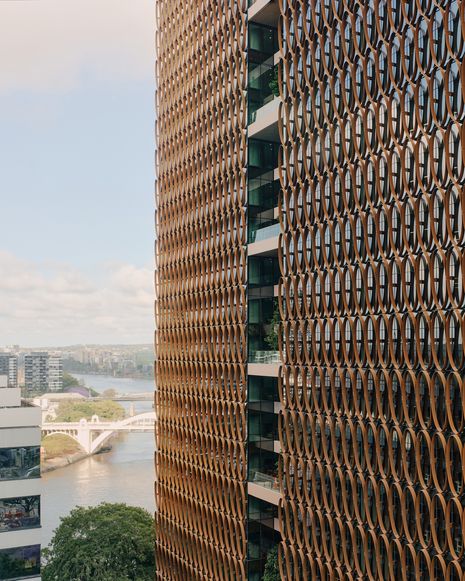
The tower carries the argument upward. The elliptical facade is a highly recognisable element, but its value lies in being more than a visual signature. The ovoid-patterned screening system emerged through iterative environmental studies as a way of avoiding the familiar fallback of dark-tinted glass while still meeting demanding performance targets. Too many office towers still collapse technical competence into visual blankness. Here, the facade has depth, modulation and a certain softness. The effect shifts with the angle of view: seen frontally, the metal elements appear remarkably fine; seen obliquely, their depth is magnified, and the facade gathers density. Set within that veiled surface, the terraces register as small voids, interrupting the screen’s continuity and giving the elevations a more open and inhabited character. Repeated through the tower rather than reserved for a privileged few, they extend the logic of the outdoor room vertically, making access to air and outlook part of the building’s everyday spatial contract.
There are, of course, familiar tensions. Publicly accessible space in privately owned developments is always contingent, no matter how generous the architecture. The ongoing civic contribution of this plaza will depend on management as much as design. Even so, 205 North Quay sustains a clear architectural position from competition to completion. In a development culture that often fragments buildings into marketable parts, that continuity feels rare and quietly consequential.